I am a final year Creative Industries and Visual Culture student with a strong interest in Irish history and visual culture, particularly the Arts and Crafts Movement in Ireland. This interest inspired my undergraduate thesis, which examines representations of the Crucifixion in early twentieth-century Irish stained glass and their role in constructing national identity.
Ireland on the Cross: Myth, Modernism and the Construction of Irish Identity in Stained Glass (1920-1950)
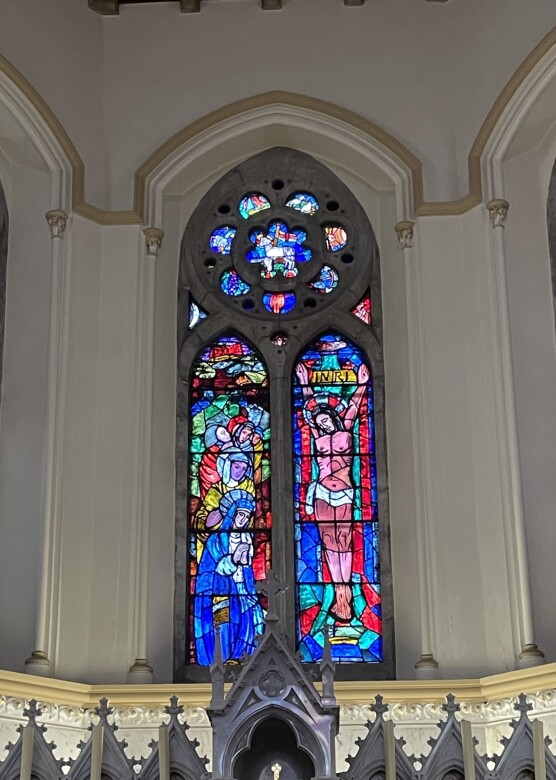
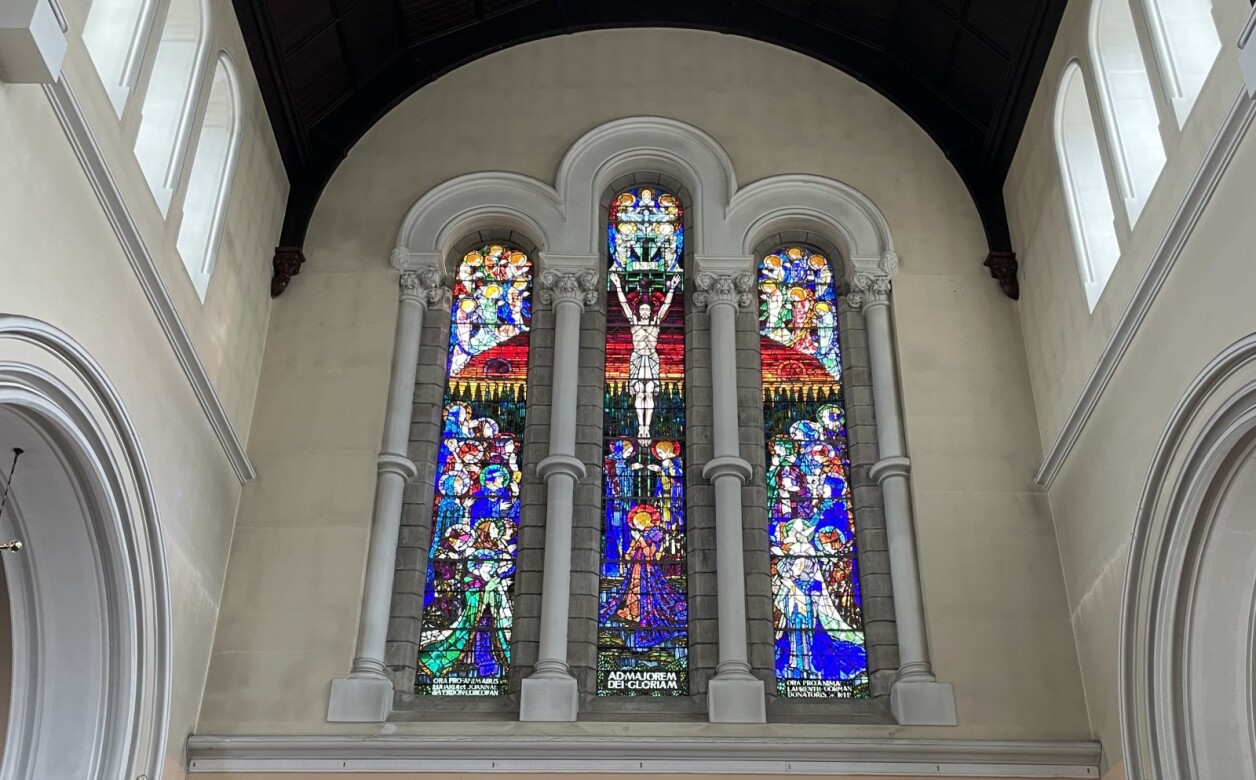
This thesis investigates the representation of the Crucifixion in Irish stained glass between 1920 and 1950 as a means of analysing the construction and transformation of Irish national identity. Focusing on Harry Clarke’s Adoration of the Cross by Irish Saints (1920) and Evie Hone’s Crucifixion at Kingscourt (1947), the study explores how religious imagery operated within a cultural landscape shaped by Catholicism, nationalism and social regulation in the newly formed Irish Free State. The research employs comparative visual analysis informed by Benedict Anderson’s concept of “imagined communities”, Roland Barthes’ theory of myth and Tom Inglis’ account of the “civilising” of the Irish body. Primary research conducted through site visits to the relevant churches further informed the analysis of scale and lighting of the stained-glass works.
The thesis finds that Clarke’s work constructs the Crucifixion as a Catholic-national myth in which the suffering and disciplined body of Christ reinforces ideals of sacrifice, endurance and Irish identity. In contrast, Hone’s later work reflects the influence of modernism and her Anglo-Irish background, adopting a more abstract and spiritually introspective visual language that destabilises the fixed ideological meaning present in Clarke’s work. Ultimately, the thesis argues that the construction of the Crucifixion as a national archetype is not only shaped by religious ideology, but by intersecting forces of nationalism, class, and gender.